01
Assessment
Look at the site, water sources, habitat and reported activity.

Knowing where mosquitoes develop can help people understand which site information matters when planning control.
Mosquitoes develop through four stages: egg, larva, pupa and adult. The first three are associated with water. The adult emerges from the pupa.
Adult females take a blood meal to develop eggs, then lay eggs and begin the cycle again. The diagram also shows the four larval growth stages.
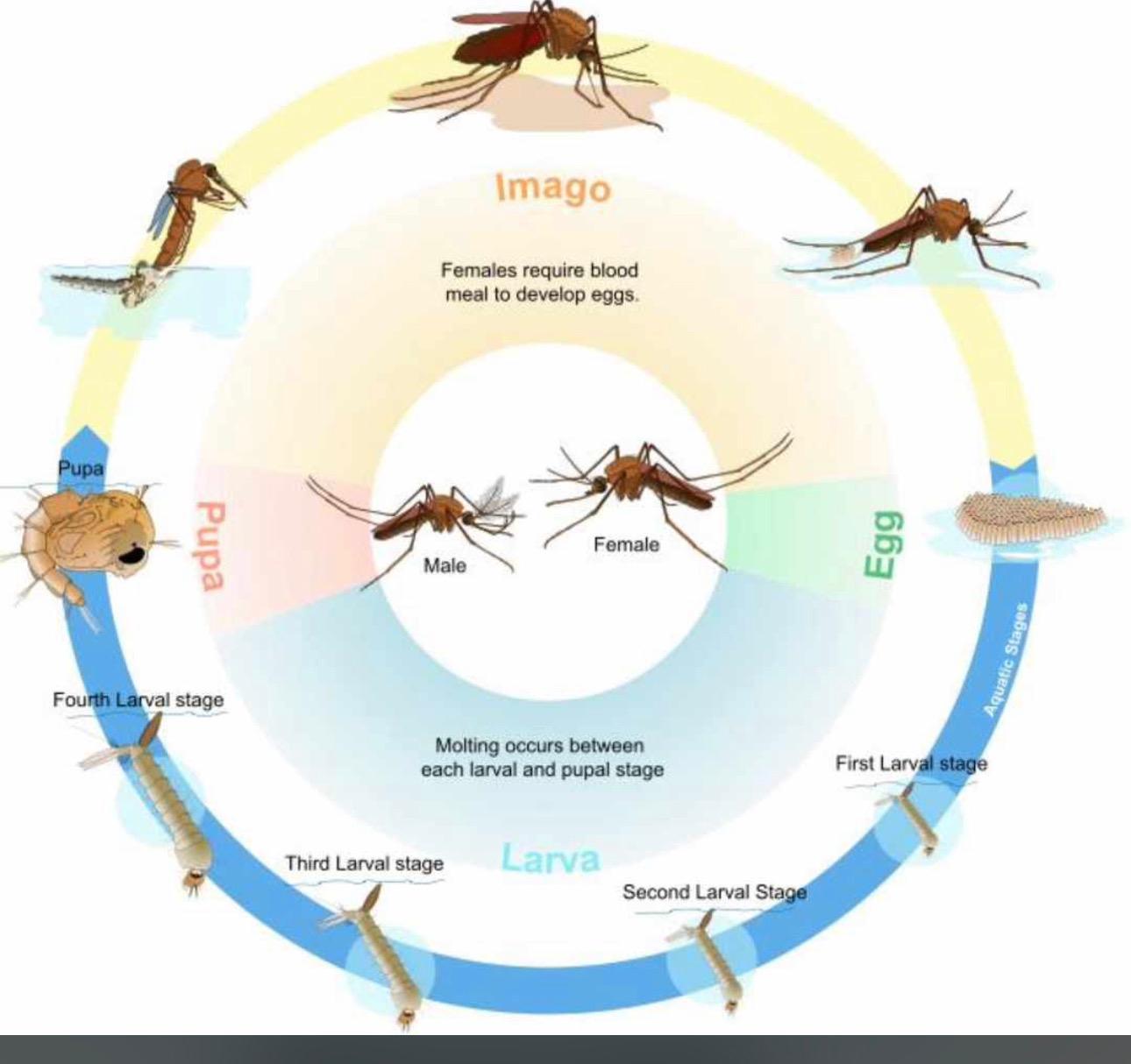
Eggs are laid on or near water and hatch into larvae.
Larvae live in water and grow through four stages.
The pupa develops in water before the adult emerges.
Females take a blood meal to develop eggs, then lay them to restart the cycle.
A mosquito-management plan can move through five stages: assess the site, monitor mosquito activity, prevent breeding where possible, choose suitable control measures and review the results. The right approach depends on local conditions and approved instructions.
Look at the site, water sources, habitat and reported activity.
Monitor where and when mosquito activity occurs and how it changes.
Reduce breeding opportunities and share practical local guidance with the community.
Approaches may be biological, physical or chemical. Qualified local teams choose suitable approved measures.
Review the results and adjust the plan if conditions or activity change.
Small, regular checks can help reduce places where mosquitoes breed.
For mosquito surveillance, trained teams may use a dipper to collect larval samples and a CDC gravid trap to monitor adult mosquitoes. They can use these observations to:
For a 55-US-gallon (about 208 L) barrel, put 1 lb (about 450 g) semi-dry horse manure, 2 oz (about 57 g) dried brewer’s yeast and 2 oz (about 57 g) egg-white powder in a small burlap (hessian) bag. Add a weight, then place 1 lb (about 450 g) dry straw or grass clippings on top. Fill the barrel with water and suspend the bag about halfway down, lowering it as the water level drops. Leave it for 3–4 days before use; a second bag is not needed. Use this only as bait in a monitored mosquito-surveillance trap, not as open, unmanaged standing water.
Environmental health services may provide site assessments, presentations, public information and coordination with other departments.
For larger sites, consider stormwater-pond retention and water quality, waste disposal, drainage, land grading and barriers, plus lighting and structural maintenance. Local environmental and public-health teams should oversee these decisions.
Species examples: Culex quinquefasciatus commonly bites from dusk to dawn, prefers birds but can feed on other mammals, and lays egg rafts in stagnant, organic-rich water. Aedes aegypti and Aedes albopictus commonly bite during the day, often prefer human hosts but may feed on other mammals, and lay single eggs on the sides of water-holding containers. Species behaviour and disease risks vary by region.
Diseases and location: Disease risks depend on local mosquito species. Some Aedes mosquitoes transmit dengue, chikungunya and Zika. Culex mosquitoes can transmit West Nile, St. Louis encephalitis or Japanese encephalitis in regions where these viruses circulate. Some Anopheles mosquitoes transmit malaria. See the WHO vector-borne disease information and local public-health guidance.
Control approaches: Programmes may combine biological, physical and chemical measures. Bti (Bacillus thuringiensis israelensis) is a naturally occurring bacterium used as a larvicide; Bacillus sphaericus is another biological option for suitable sites. These products target mosquito larvae in water. Specialist programmes may also use attractive toxic sugar baits, which combine an attractant with a toxic ingredient. Physical and environmental measures include removing standing water, maintaining drainage and managing waste and vegetation. Adult mosquitoes may be targeted around indoor or outdoor sites; method and timing depend on the species, site and current approved product label. Chemical controls must follow that label and be applied by appropriately trained people.
Health awareness: Malaria is a parasitic disease transmitted by some infected female Anopheles mosquitoes. Fever, chills and headache are common early symptoms, often starting 10–15 days after an infected bite, though symptoms can appear later. These signs are not specific, so seek prompt medical assessment after possible exposure in a malaria-risk area. Infants, children under five, pregnant women, travellers and people with HIV are at higher risk of severe illness; malaria during pregnancy can cause premature delivery or low birth weight. Extreme tiredness, confusion or reduced consciousness, seizures, difficulty breathing, jaundice, dark or bloody urine, or abnormal bleeding require emergency care. See the WHO malaria information and follow local health advice.